
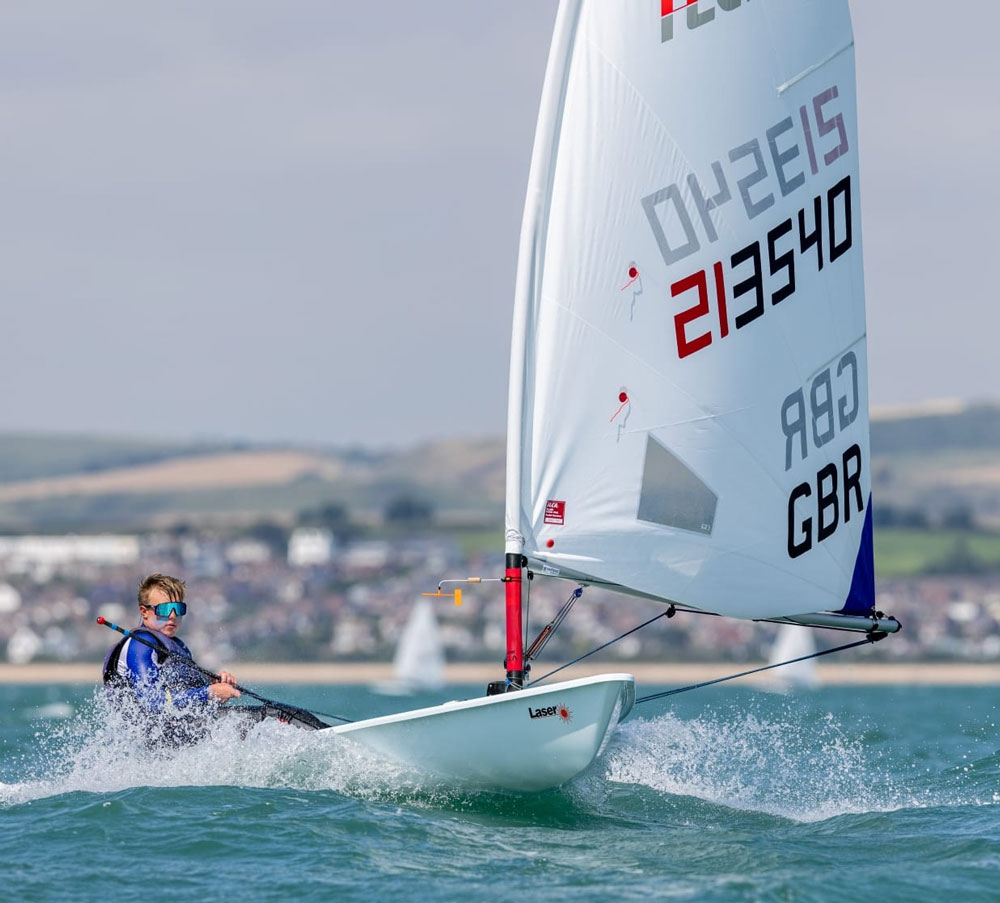
The ILCA 6, historically known and raced as the Laser Radial, operates as a strict one-design, single-handed racing dinghy. Built upon a unified 4.23-meter (13.88-foot) fiberglass hull shared across the entire International Laser Class Association (ILCA) ecosystem, the ILCA 6 represents the intermediate step in the platform’s rigging hierarchy. Introduced in 1982, the ILCA 6 modification utilizes a self-contained sail plan specifically engineered for a targeted weight band of sailors, primarily those between 60 kg and 75 kg (132 to 165 lbs).
The fundamental architecture of the boat features a cat rig setup, meaning it carries only a single mainsail and no headsail or jib. Unlike developmental classes where naval architects constantly iterate on hull shapes or foil designs to extract fractions of a knot in speed, the ILCA 6 relies on absolute manufacturing uniformity. The governing principle of the class dictates that every hull, spar, and foil must be produced to identical parameters. This theoretically eliminates equipment advantages, isolating the athlete’s physical conditioning, tactical awareness, and kinetic boathandling as the sole variables determining race outcomes.
Currently utilized as the official equipment for the Women’s Single-Handed Olympic sailing event, the ILCA 6 carries a 5.76 square meter (62.0 square feet) mainsail. The visual identifier for the class during international fleet racing is a red rhombus positioned on the mainsail. The unballasted hull has a total weight of 58.97 kg (130.0 lbs), creating an ultra-light displacement vessel that demands significant kinetic input from the sailor to maintain a flat transverse profile in the water.
Core Dimensional Specifications of the ILCA 6
| Measurement Metric | Imperial Specification | Metric Specification |
| Length Overall (LOA) | 13.88 ft | 4.23 m |
| Waterline Length (LWL) | 12.50 ft | 3.81 m |
| Maximum Beam | 4.49 ft | 1.37 m |
| Draft (Centerboard Down) | 2.62 ft | 0.80 m |
| Bare Hull Weight | 130.0 lbs | 58.97 kg |
| Optimal Sailor Weight | 132 – 165 lbs | 60 – 75 kg |
History
The baseline hull architecture that supports the ILCA 6 was originally conceived in 1969. Industrial designer Ian Bruce and sailor Bruce Kirby conceptualized a cartoppable dinghy, initially named the “Weekender,” intended for mass recreational production. The prototype of this 4.23-meter hull debuted at the 1970 America’s Teacup regatta, demonstrating exceptional hydrodynamic efficiency. It entered commercial production in 1971 under the name “Laser” and rapidly became the highest-volume single-handed racing dinghy globally.
However, the original configuration—now known as the ILCA 7—carried a 7.06 square meter sail that proved structurally overpowering for sailors weighing less than 75 kg, particularly in wind speeds exceeding 12 knots. To resolve this demographic limitation without requiring the manufacturing of an entirely new hull mold, the Laser Radial (ILCA 6) was developed and released in 1982. The innovation lay in a modular approach: by retaining the standard hull, boom, and upper mast section, but substituting a more flexible lower mast and a smaller 5.76 square meter sail, the class expanded its accessibility.
The Radial’s integration into high-performance racing was systematic. It became the dominant youth and women’s platform throughout the 1990s and early 2000s. Its definitive competitive validation occurred when World Sailing (then ISAF) selected the Laser Radial as the equipment for the Women’s Single-Handed Olympic class, making its debut at the 2008 Beijing Olympic Games. Since then, the class has maintained its Olympic status across London 2012, Rio 2016, Tokyo 2020, and Paris 2024.
In 2019, following complex international trademark disputes regarding the “Laser” brand name among its various global manufacturers, the class officially rebranded. The boats are now manufactured and raced under the International Laser Class Association (ILCA) designation, with the Radial specifically reclassified as the ILCA 6.
Historical Timeline of the ILCA 6 Development
| Year | Milestone | Data Point / Significance |
| 1969 | Hull Concept | Bruce Kirby and Ian Bruce draft the original 4.23m hull lines. |
| 1971 | Commercial Launch | The original full-rig Laser enters mass production. |
| 1982 | Radial Rig Introduction | The 5.76 m2 sail and flexible lower mast are released for 60-75 kg sailors. |
| 2008 | Olympic Debut | Selected for the Women’s Single-Handed event at the Beijing Games. |
| 2019 | Class Rebranding | Trademark disputes lead to the official ILCA 6 nomenclature. |
| 2024 | Continued Olympic Status | ILCA 6 utilized at the Paris 2024 Olympic Games in Marseille. |
Design
The hydrodynamic geometry of the ILCA 6 is engineered to optimize performance in two distinct physical states: displacement sailing in low wind velocities and hydrodynamic planing in elevated wind states. The hull features a shallow, U-shaped forward section that transitions into a relatively flat bottom with a hard chine moving aft. This flat aft section reduces the wetted surface area and allows the vessel to detach from its bow wave, effectively surfing over the water rather than pushing through it.
The boat’s Displacement to Length (D/L) ratio sits at 29.26, categorizing it firmly as an ultra-light displacement boat. Because it lacks a weighted keel, relying instead on a buoyant unballasted hull and a fiberglass daggerboard, the Capsize Screening Ratio is recorded at 3.56, indicating extreme sensitivity to weight distribution and a high probability of capsizing if not dynamically balanced by the crew.
The deck layout is functionally minimalist. The cockpit is intentionally small to reduce the volume of water retained during a capsize recovery, and it incorporates a self-bailing scupper. The deck’s sheerline features a pronounced lip, which serves a dual structural and ergonomic purpose: it bonds the deck molding to the hull molding while providing a rolled edge for the sailor’s legs during prolonged hiking maneuvers. The mast step, a fiberglass tube molded directly into the deck and anchored to the hull floor, absorbs immense torsional loads, as the mast operates without the support of shrouds or a forestay.
Hydrodynamic and Theoretical Performance Ratios
| Ratio / Metric | Value | Interpretation |
| Sail Area to Displacement (SA/D) | 39.06 | Highly powered ratio; dictates the necessity of active crew hiking for stability. |
| Displacement to Length (D/L) | 29.26 | Ultra-light displacement category; enables rapid acceleration and planing. |
| Comfort Ratio | 2.07 | extremely low value; prioritizes speed and feedback over motion comfort. |
| Capsize Screening Ratio | 3.56 | Values over 2.0 indicate high capsize vulnerability; standard for racing dinghies. |
| Theoretical Hull Speed | 4.74 knots | The velocity limit before the hull must transition into a plane to increase speed. |
Propulsion
Propulsion in the ILCA 6 is entirely wind-driven via a 5.76 square meter (62.0 sq ft) mainsail constructed from woven Dacron cloth. The nomenclature “Radial” originates from the sailmaking technique employed in its construction. Unlike older cross-cut sails, the ILCA 6 mainsail features panels radiating outward from the clew (the lower aft corner) to the luff (the forward edge) and leech (the aft edge). This radial cut aligns the warp of the sailcloth with the primary load paths generated by the mainsheet and vang, effectively reducing stretch and maintaining the aerodynamic draft profile under heavy wind loads.
The cat rig consists of a two-part, unstayed tubular mast. The ILCA 6 utilizes the exact same upper mast section and boom as the larger ILCA 7. However, the critical point of differentiation is the ILCA 6 lower mast section. This component is physically shorter and engineered with a specifically calibrated flex response.
When the wind speed increases, the sailor applies tension to the vang (a 15:1 mechanical purchase block system) and the cunningham (an 8:1 purchase system). Because the mast is unstayed, this tension induces an aftward bend in the mast. The flexible lower mast of the ILCA 6 bows significantly under these loads, which actively flattens the camber of the sail and causes the leech to fall away, spilling excess aerodynamic force. This structural depowering mechanism is what allows a 65 kg sailor to maintain physical control over the boat in 20-knot winds without being overpowered. The control suite is restricted to just four adjustable lines: mainsheet, vang, cunningham, and outhaul.
Sail Plan and Rigging Specifications
| Component | Specification | Material / Metric |
| Rig Type | Cat Rig | Unstayed, single mainsail configuration |
| Total Sail Area | 5.76 m2 (62.0 sq ft) | Dacron, radial cut panel layout |
| Lower Mast Characteristic | Flexible | Engineered for dynamic bend to depower the sail |
| Vang Purchase System | 15:1 maximum | Cascading block arrangement |
| Outhaul Purchase System | 6:1 maximum | Controls draft depth in the lower third of the sail |
| Cunningham Purchase System | 8:1 maximum | Controls draft position and leech tension |
Construction and Materials
Strict adherence to the class construction manual ensures global uniformity across all authorized ILCA builders. The primary material for both the hull and deck is glass-reinforced plastic (GRP), laid over a localized foam core in high-stress areas to increase structural rigidity without violating the strict 58.97 kg weight floor. During manufacturing, if a bare hull exits the mold under the minimum weight requirement, permanent corrector weights are bonded to the boat to ensure parity. An excessively heavy hull, conversely, operates at a permanent competitive disadvantage.
The foil package—comprising the daggerboard and the rudder—is constructed from a high-density polyurethane foam core encapsulated within a fiberglass and epoxy matrix. The daggerboard operates within a trunk located directly aft of the mast step, while the rudder attaches to transom gudgeons via a simple pintle-and-clip mechanism, streamlining launch and recovery.
Material evolution within the class is highly conservative. Historically, all spars (upper mast, lower mast, and boom) were extruded from marine-grade aluminum alloy. However, repeated fatigue failures and permanent bending of aluminum upper masts under extreme vang tension prompted the class to authorize carbon composite upper masts and carbon lower masts for the ILCA 6. These composite spars match the identical bend characteristics and weight parameters of their aluminum predecessors but offer superior elastic memory, returning to perfectly straight orientations after extreme loading cycles.
Material Composition of Major Components
| Component | Permitted Material | Structural Note |
| Hull Shell | GRP (Fiberglass) | Localized foam coring for deck stiffness. |
| Daggerboard | GRP over high-density foam | Strictly regulated trailing and leading edge profiles. |
| Rudder Blade | GRP over high-density foam | Uniform hydrodynamic foil shape across all builders. |
| Upper Mast | Aluminum or Carbon Composite | Carbon offers identical bend but higher fatigue resistance. |
| ILCA 6 Lower Mast | Aluminum or Carbon Composite | Specifically engineered flex profile for the 5.76 m2 sail. |
| Boom | Extruded Aluminum | Shared across all three ILCA rig sizes. |
ILCA Class Measurement Tolerances
| Measurement Target | Specified Value | Competitive Implication |
| Minimum Hull Weight | 58.97 kg | Hulls under this limit require permanent corrector weights. |
| Maximum Beam | 1.39 m | Hull width dictates hiking leverage; strictly capped. |
| Sail Area | 5.76 m2 | Template-measured to prevent unauthorized aerodynamic enhancements. |
| Daggerboard Width | 280 mm max | Ensures uniform lateral resistance and wetted surface area. |
Types
The operational genius of the platform lies in its modular ecosystem. The ILCA class functions across three distinct rig classifications, all utilizing identical hulls, centerboards, rudders, booms, and upper masts. The physical transformation between the types requires only the substitution of the lower mast tube and the sail. This interchangeability allows a sailor to enter the class at a low body weight and progress through the rigs as their physiology develops, avoiding the financial friction of purchasing entirely new boats.
-
ILCA 4 (formerly Laser 4.7): The entry-level configuration, carrying a 4.70 square meter sail and a pre-bent lower mast. This rig is scaled for youth sailors weighing between 45 and 55 kg (100-120 lbs).
-
ILCA 6 (formerly Laser Radial): The intermediate configuration and Women’s Olympic class. Carrying the 5.76 square meter sail and a flexible lower mast, it is optimized for sailors in the 60 to 75 kg (132-165 lbs) range.
-
ILCA 7 (formerly Laser Standard): The original configuration and Men’s Olympic class. It utilizes a stiff lower mast and a 7.06 square meter sail, generating massive righting moment requirements optimized for athletes between 73 and 86 kg.
Comparison of ILCA Rig Configurations
| Specification | ILCA 4 (Laser 4.7) | ILCA 6 (Laser Radial) | ILCA 7 (Laser Standard) |
| Sail Area | 4.70 m2 (50.59 sq ft) | 5.76 m2 (62.00 sq ft) | 7.06 m2 (76.00 sq ft) |
| Lower Mast Characteristic | Pre-bent Aluminum | Flexible Aluminum / Carbon | Stiff Aluminum |
| Relative Sail Area vs ILCA 7 | 33% smaller | 18% smaller | Baseline (100%) |
| Optimal Sailor Weight Band | 45 – 55 kg | 60 – 75 kg | 73 – 86 kg |
| Olympic Event Status | Youth Transition | Women’s Single-Handed | Men’s Single-Handed |
Anthropometrics and Performance Metrics
Due to the strict one-design nature of the ILCA 6, equipment variables are neutralized, shifting the performance burden entirely onto the physiological and biomechanical output of the sailor. Sailing an ILCA 6 efficiently upwind requires the athlete to hike—suspending their torso outboard over the water with only their feet hooked under a cockpit strap. This creates a human counterweight (righting moment) to balance the aerodynamic force acting on the sail.
Quantitative data gathered from high-level competition provides a precise anthropometric blueprint for success in the ILCA 6 class. A comprehensive peer-reviewed study analyzed the anthropometric characteristics of 150 Olympic ILCA 6 sailors who competed in the 2008, 2012, 2016, and 2021 Summer Olympic Games.
The empirical findings from this dataset establish a highly specific physical prototype. The average body weight of the Olympic competitors was 66.15 kg (standard deviation ± 3.88 kg), while the average height was 171.51 cm (standard deviation ± 5.02 cm). The mean Body Mass Index (BMI) was recorded at 22.5 kg/m2. The data indicated that 82.7% of the elite fleet fell strictly within the 62 kg to 70 kg weight band. Sailors deviating significantly below this weight lack the leverage required to keep the hull flat in winds exceeding 15 knots, suffering from excessive hydrodynamic leeway. Conversely, sailors exceeding this weight band incur a penalty in overall power-to-weight ratio during light-air displacement racing, resulting in slower acceleration.
Furthermore, the data revealed a moderate negative correlation between race performance and age (r = -0.336), with 63.8% of the Olympic fleet concentrated between the ages of 20 and 28. This statistical concentration underscores the extreme cardiovascular and isometric strength requirements demanded by the ILCA 6 at the elite level, which peak during an athlete’s mid-twenties.
Anthropometric Data of Olympic ILCA 6 Sailors (2008-2021)
| Metric | Mean Value | Standard Deviation | Dominant Range (Concentration) |
| Body Weight | 66.15 kg | ± 3.88 kg | 62 – 70 kg (82.7% of sailors) |
| Body Height | 171.51 cm | ± 5.02 cm | 1.65 – 1.76 m (81.4% of sailors) |
| Age | 25.59 years | ± 4.83 years | 20 – 28 years (63.8% of sailors) |
| Body Mass Index (BMI) | 22.5 kg/m2 | ± 1.48 kg/m2 | 21.0 – 24.0 kg/m2 |
Conclusion
The introduction of the ILCA 6 (Laser Radial) in 1982 stands as a defining moment in marine architecture, not through a radical departure in hull design, but through highly calculated modularity. By precisely reducing the sail area to 5.76 square meters and engineering a specifically flexible lower mast, Bruce Kirby and the class manufacturers recalibrated the power-to-weight ratio of the world’s most ubiquitous racing dinghy.
The empirical data highlights the exactness of this calibration. Anthropometric studies of Olympic athletes confirm that the rig perfectly accommodates sailors in the 66 kg weight range, generating a highly competitive, physically demanding racing environment that strictly isolates human performance from equipment variance. With a strict 58.97 kg hull weight, a heavily regulated 4.23-meter waterline, and an uncompromising one-design manufacturing standard, the ILCA 6 provides a purely data-driven, measurable platform for single-handed racing. The boat’s sustained presence as an Olympic discipline since 2008 and its vast adoption worldwide underscore its functional efficiency and its unyielding demand for supreme tactical and physical proficiency on the water.