
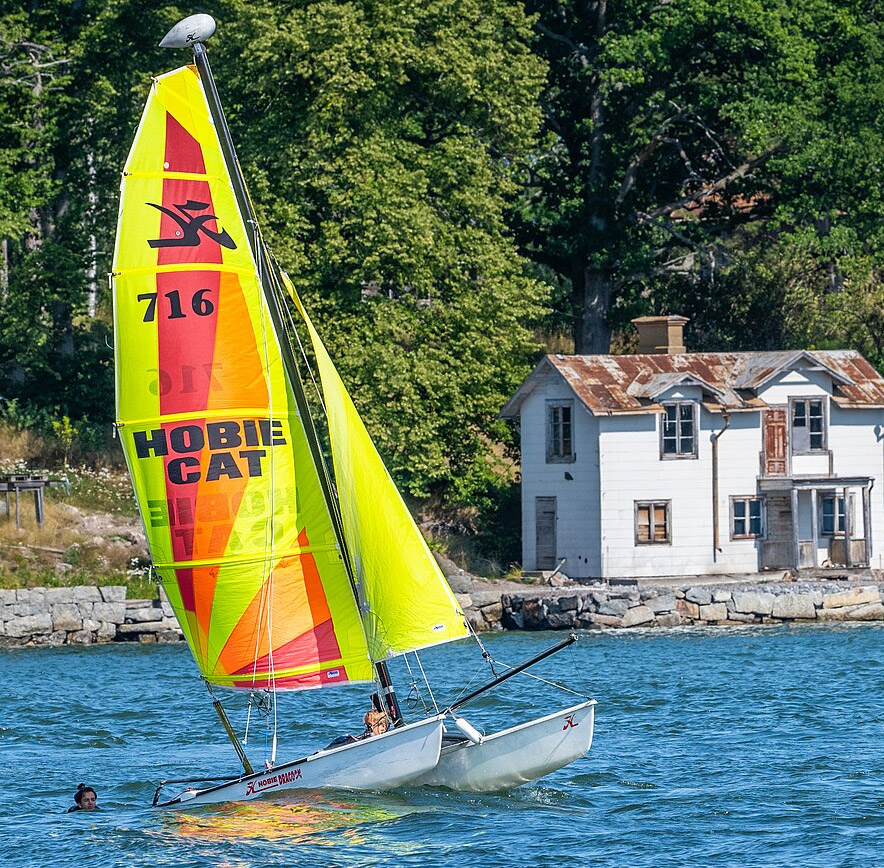
Training the next generation of high-performance sailors requires a platform that accurately scales the hydrodynamic and aerodynamic forces of adult racing catamarans down to a manageable size. Introduced in the early 2000s by Hobie Cat Europe, the Hobie Dragoon was engineered precisely for this purpose.
Operating in a highly specific niche, the Dragoon bridges the massive gap between single-handed monohull dinghies (like the Optimist) and high-powered adult multihulls like the Hobie 16 or Formula 16. By incorporating symmetrical hulls, a fractional sloop rig, twin trapezes, and an asymmetrical spinnaker into a 13-foot footprint, the Dragoon allows young sailors (typically aged 12 to 14) to master advanced multihull physics safely.
We will break down the structural data, sail area ratios, and specific design choices that allow the Hobie Dragoon to function as an ISAF (World Sailing) International Class youth trainer.
Description
The Hobie Dragoon is a 3.91-meter (12 ft 10 in) unballasted beach catamaran. Designed to be raced by a double-handed crew of youth sailors, the vessel must maintain strict weight and dimensional tolerances to ensure that the physical demands do not exceed the biological capabilities of a 12-year-old.
Unlike adult catamarans that often require a minimum crew weight of 130 kg to 150 kg, the Dragoon is mathematically optimized for a combined crew weight of 100 kg to 120 kg (220 lbs to 264 lbs). The platform weight is kept extremely light, tipping the scales at just 98 kg (216 lbs).
By analyzing the primary specifications, we can see exactly how the naval architects scaled down a high-performance multihull.
Primary Dimensions and Baselines
| Specification | Metric Value | Imperial Value | Engineering Context |
| Length Overall (LOA) | 3.91 m | 12.83 ft | Short waterline limits top speed, keeping the boat safe for juniors. |
| Maximum Beam | 2.20 m | 7.22 ft | Wide stance relative to length (LOA/Beam ratio of 1.77) maximizes righting moment. |
| Platform Weight | 98.00 kg | 216.00 lbs | Light enough for two children to launch and right after a capsize. |
| Mast Height | 6.40 m | 21.00 ft | Low center of effort to prevent excessive pitch-poling. |
| Optimal Crew Weight | 100 – 120 kg | 220 – 264 lbs | Target mass required to flatten the hulls in 15 knots of wind. |
| Crew Configuration | 2 Persons | 2 Persons | Mandates communication and synchronized weight placement. |
The critical ratio here is the beam (2.20 m) relative to the mast height (6.40 m). The wide beam provides the crew with significant leverage when out on the trapeze wire, allowing them to counteract the aerodynamic force generated by the sails without requiring heavy physical mass.
History
The Hobie Dragoon was conceptualized and introduced by Hobie Cat Europe around 2001. At the time, the sailing industry faced a retention problem. Children who learned to sail in slow, single-handed monohulls (like the Optimist) often found the jump to high-speed, adult catamarans (like the Hobie 16 or Hobie Tiger/Formula 18) too physically demanding and intimidating.
The Dragoon was developed in direct collaboration with European sailing schools to create a stepping stone. The goal was to build a boat that could be sailed as a basic trainer (main and jib only) and then upgraded with a twin trapeze and spinnaker kit as the sailors advanced in skill.
Due to its precise engineering and strict one-design manufacturing, the International Sailing Federation (ISAF, now World Sailing) granted the Dragoon International Class status. This recognition allowed the class to host sanctioned World Championships, formally establishing it as a definitive youth pathway class globally.
Historical Context of Youth Multihulls
| Class | Year Introduced | Target Crew | Primary Function |
| Optimist (Monohull) | 1947 | 1 Child (Under 15) | Baseline monohull trainer; extremely slow but highly tactical. |
| Hobie 14 | 1968 | 1 Adult / Older Teen | The original beach cat; asymmetric hulls, overpowered for young children. |
| Hobie Dragoon | 2001 | 2 Youth (Age 12-14) | Scaled-down trainer introducing spinnakers and twin trapezes to juniors. |
| Nacra 15 | 2015 | 2 Youth (Age 15-19) | High-performance youth pathway for the Olympic Nacra 17; utilizes curved daggerboards. |
Design
The hull geometry of the Hobie Dragoon differs significantly from the older Hobie 14 and 16 models. While the legacy Hobies utilized heavily rockered (banana-shaped), asymmetric hulls to generate lift, the Dragoon features symmetrical hulls.
A symmetrical hull pushes through the water with less wetted surface area drag than an asymmetric hull, especially at lower speeds. However, because symmetrical hulls do not generate lateral lift (the force that stops a boat from sliding sideways downwind), the boat requires an appendage to resist leeway.
Instead of using deep, retractable daggerboards (which are complex, expensive, and easily broken if run aground), Hobie Cat Europe integrated fixed skegs into the bottom of the Dragoon’s hulls. These skegs act as shallow, elongated keels. While they do not allow the Dragoon to point quite as high into the wind as a daggerboard-equipped boat, they are virtually indestructible and allow the boat to be dragged directly onto a beach.
Lateral Resistance Comparison
| Naval Architecture Method | Example Boat | Advantage | Disadvantage |
| Asymmetrical Hulls | Hobie 16 | No moving parts; extreme durability in surf. | High hydrodynamic drag at speed; suffers flow separation. |
| Deep Daggerboards | Formula 18 | Maximum upwind pointing angle; high lift/low drag. | Fragile; catastrophic damage if grounded; requires crew management. |
| Symmetrical + Fixed Skegs | Hobie Dragoon | Highly durable; minimal crew distraction; lower drag than asymmetric. | Pointing angle is slightly lower than daggerboards. |
To manage the volume distribution, the bows of the Dragoon have significantly more buoyancy forward than legacy Hobie designs. This forward volume helps prevent “pitch-poling”—a catastrophic capsize where the leeward bow submarines under the water, a common issue when inexperienced sailors apply too much power downwind.
Propulsion
Propulsion on the Hobie Dragoon operates on the principles of a fractional sloop rig. Depending on the configuration, the propulsion system can adapt from a simple two-sail setup to a highly complex three-sail rig.
The primary engine is the fully battened mainsail. Full-length battens force the Dacron or Mylar sailcloth to hold a rigid aerodynamic airfoil shape (draft) even in heavy gusts. If the sail were unbattened, it would simply flap and lose all forward thrust. The jib works in concert with the main, creating a “slot effect” that accelerates the airflow over the leeward side of the mainsail, dramatically increasing lift.
Sail Plan Geometry and Aerodynamic Output
| Sail Component | Surface Area (Metric) | Surface Area (Imperial) | Aerodynamic Function |
| Mainsail | 9.50 m² | 102.00 sq ft | Primary upwind drive; fully battened to maintain chord depth. |
| Jib | 2.20 m² | 23.70 sq ft | Accelerates airflow; often rigged on a roller furler for safety. |
| Asymmetrical Spinnaker | 8.10 m² | 87.20 sq ft | Optional high-lift foil deployed for off-wind apparent sailing. |
| Total Upwind Area | 11.70 m² | 125.70 sq ft | Managed by mainsheet tension and downhaul. |
| Total Downwind Area | 19.80 m² | 212.90 sq ft | Total area when spinnaker is deployed alongside main and jib. |
The introduction of the 8.10 square meter asymmetrical spinnaker is the Dragoon’s most critical educational feature. On older catamarans, sailors simply let the mainsail out and sailed straight downwind. With an asymmetrical spinnaker, the Dragoon sails “hot” angles (tacking downwind). As the boat speeds up, the apparent wind shifts forward, keeping the spinnaker pressurized like an aircraft wing rather than a parachute. This teaches 12-year-olds the exact apparent wind physics they will need to race adult F18s or Nacras a few years later.
Construction and Materials
Maintaining a rigid 98 kg platform that can withstand the torsional twisting forces of twin hulls and the compression loads of a 6.4-meter mast requires specific composite engineering. The Hobie Dragoon utilizes a fiberglass and foam sandwich construction.
In a foam sandwich layup, a core of closed-cell polyurethane or PVC foam is sandwiched between an inner and outer skin of woven fiberglass saturated with resin. By physically separating the two fiberglass skins with the foam core, the moment of inertia of the hull panel is exponentially increased. This provides massive structural stiffness without the prohibitive weight penalty of using solid, hand-laid fiberglass.
Material Composition Breakdown
| Component | Construction Material | Engineering Rationale |
| Hulls | Fiberglass/Foam Sandwich | Maximizes panel stiffness to weight ratio; provides inherent positive buoyancy if swamped. |
| Mast | Extruded Aluminum Alloy | Ensures uniform bend characteristics and keeps replacement costs low for sailing schools. |
| Crossbeams | Extruded Aluminum Alloy | Resists the immense torsional loads when one hull hits a wave while the other is suspended. |
| Rudders | Composite / Plastic | Transom-hung and kick-up designed to snap upward if run aground, preventing transom damage. |
| Trampoline | Woven Mesh | Allows water to drain instantly, reducing hydrodynamic weight when waves wash over the deck. |
The standing rigging (the wires that hold the mast up) is constructed from 1×19 stainless steel wire. This specific wire weave is designed to manage the high static compression loads—often exceeding several hundred pounds of tension on the forestay—without stretching over time.
Types and Configurations
To serve both introductory sailing schools and competitive youth racing circuits, the Dragoon is generally scaled through hardware additions rather than structural hull changes. The base hull geometry and 98 kg weight remain constant across all configurations.
Dragoon Club (Training Configuration)
Designed for basic initiation and sailing schools, the “Club” configuration focuses on simplicity. It is typically rigged with just the mainsail and jib (11.70 m² total sail area) and features a single trapeze system (or sometimes no trapeze for absolute beginners). The jib is often mounted on a roller furler, allowing the instructor or youth crew to instantly roll the sail up if the wind increases unexpectedly.
Dragoon Extreme (Racing Configuration)
This is the ISAF-compliant racing setup. It adds the 8.10 m² asymmetrical spinnaker, a spinnaker pole (bowsprit) extending from the front crossbeam, and a twin trapeze system. In this configuration, both the helm and the crew clip their harnesses onto the trapeze wires and suspend their entire body weight off the side of the hull. This maximizes the righting moment, allowing the 100-120 kg crew to keep the boat perfectly flat while harnessing the massive power of the spinnaker on a downwind run.
Dragoon Club vs. Dragoon Extreme Configuration
| Specification | Dragoon Club (Trainer) | Dragoon Extreme (Racer) |
| Rig Type | Fractional Sloop (Main/Jib) | Fractional Sloop + Spinnaker |
| Total Sail Area (Downwind) | 11.70 m² | 19.80 m² |
| Trapeze System | Single or None | Double (Twin) Trapeze |
| Jib Management | Roller Furling | Standard / Roller Furling |
| Primary Focus | Safety, basic mechanics, balance | Apparent wind optimization, high-speed tactical racing |
Performance Data and Class Comparisons
To objectively quantify the speed and efficiency of the Hobie Dragoon, we look at empirical handicap rating systems such as the Small Catamaran Handicap Rating System (SCHRS) or the Portsmouth Yardstick (PY). These systems calculate a boat’s theoretical speed over a closed course; a lower number mathematically designates a faster vessel.
When comparing the Dragoon to other youth trainers, the data clearly illustrates its position as a high-speed transition vessel.
Empirical Performance Metrics (Approximate Handicaps)
| Boat Class | Target Demographic | Approximate SCHRS / PY Rating | Speed Ranking |
| Nacra 15 | Older Youth (15-19) | SCHRS ~ 1.070 | 1 (Fastest) |
| Hobie Dragoon | Junior Youth (12-14) | SCHRS ~ 1.220 | 2 |
| Hobie 14 | Solo Adult | SCHRS ~ 1.250 | 3 |
| Laser (ILCA 4/4.7) | Junior Youth Monohull | PY ~ 120.0 | 4 |
| Optimist | Child (Under 15) | PY ~ 164.0 | 5 (Slowest) |
The data reveals that the 13-foot Dragoon is mathematically faster around a racecourse than the legacy Hobie 14, largely due to the efficiency of the symmetrical hulls and the massive downwind power of the asymmetrical spinnaker. However, it remains slower (and therefore safer and less intimidating) than the Nacra 15, which is longer, wider, and utilizes curved daggerboards to generate partial hydrofoiling lift.
Conclusion
The Hobie Dragoon, designed by Hobie Cat Europe, operates as a highly calculated engineering solution to a specific demographic requirement: safely teaching 12 to 14-year-olds the physics of high-performance multihull sailing.
By establishing strict baseline parameters—specifically the 3.91-meter length, 2.20-meter beam, and 98 kg platform weight—the architects ensured the vessel’s righting moment matched the 100-120 kg biological mass of a junior crew. The strategic use of symmetrical hulls with fixed skegs eliminated the fragility and complexity of daggerboards while maintaining higher hydrodynamic efficiency than older asymmetrical designs.
Most importantly, the integration of a twin trapeze system and an 8.10 m² asymmetrical spinnaker transforms the Dragoon from a basic beach toy into an empirical training platform. It forces youth sailors to master apparent wind dynamics, synchronized weight placement, and multi-sail power management—data-driven skills that directly translate to Olympic-class or Formula 18 racing in their adult careers.