
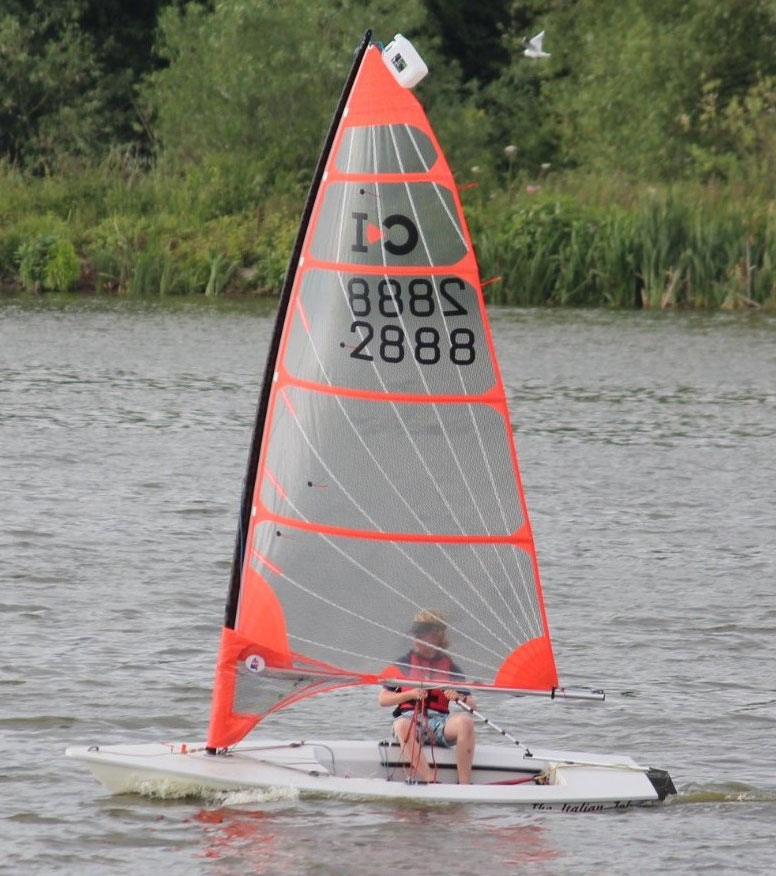
The Byte is a highly technical, single-handed racing dinghy engineered specifically to optimize performance for lighter-weight sailors. Functionally acting as a scaled-down counterpart to the ubiquitous ILCA 7 (formerly Laser), the Byte addresses a fundamental biomechanical challenge in single-handed sailing: providing a high-performance, strictly one-design platform that can be sailed efficiently by athletes weighing between 90 lbs and 145 lbs (41 kg to 66 kg) without suffering from the overpowering hydrodynamic and aerodynamic forces that characterize larger hulls.
Operating with a cat rig—a single mainsail and no jib—the Byte features a 12-foot (3.66-meter) hull. The design philosophy strictly mandates that all equipment is identical, thus removing equipment tuning from the competitive equation. Success in the Byte class is determined entirely by the sailor’s kinetic handling, tactical decision-making, and physical endurance. The vessel requires significant core strength and cardiovascular fitness to maintain a flat hull trajectory, particularly when wind velocities exceed 15 knots.
Core Dimensional Specifications of the Byte Dinghy
| Measurement Metric | Imperial Specification | Metric Specification |
| Length Overall (LOA) | 12.00 ft | 3.66 m |
| Waterline Length (LWL) | 11.20 ft | 3.41 m |
| Maximum Beam | 4.27 ft | 1.30 m |
| Draft (Centerboard Down) | 2.50 ft | 0.76 m |
| Bare Hull Weight | 100.0 lbs | 45.36 kg |
| Optimal Sailor Weight | 90 – 145 lbs | 41 – 66 kg |
History
While the title “Byte designed by Ian Bruce construction in 1973” establishes the foundational legacy of Ian Bruce’s design philosophy, it is critical to contextualize the timeline using verifiable manufacturing data. Ian Bruce, a Canadian industrial designer, is most widely recognized for his instrumental role in designing and manufacturing the original Laser dinghy alongside Bruce Kirby between 1969 and 1971. His work in the 1970s established the benchmark for high-volume, single-handed, one-design fiberglass boat construction.
The specific architectural blueprints and initial construction of the Byte dinghy, however, were formalized in 1990. Bruce recognized a statistical gap in the demographic data of sailing: the Laser platform, even with its smaller Radial (ILCA 6) rig, mechanically overpowered youth sailors and adult women whose body mass index (BMI) fell below the threshold required to generate adequate righting moment. Bruce designed the Byte to fill this exact void, applying the mass-production composite techniques he pioneered in the 1970s to a smaller, more refined hull shape.
The Byte achieved international recognition when it was selected as the equipment for the Youth Olympic Games, specifically utilizing the modernized Byte CII carbon rig. The class remains highly active in North America, Europe, and Asia, functioning as both a training platform and a terminal competitive class for lighter athletes.
Historical Timeline of the Byte Class
| Year / Era | Milestone | Data Point / Significance |
| 1970s | Foundation | Ian Bruce establishes mass-production techniques with the Laser. |
| 1990 | Original Design | The Byte is designed by Ian Bruce to accommodate 90-145 lb sailors. |
| 2004 | CII Rig Introduction | Development of a fully battened Mylar sail and carbon fiber mast. |
| 2010 | Youth Olympic Selection | Byte CII chosen for the inaugural Youth Olympic Games in Singapore. |
| 2014 | Continued Olympic Status | Byte CII utilized at the Nanjing Youth Olympic Games. |
Design
The hydrodynamic profile of the Byte hull is engineered for dual-state performance: efficient fluid displacement in low wind conditions, and rapid transition to hydrodynamic planing when wind velocity provides sufficient kinetic energy. The hull shape features a relatively narrow waterline beam and a subtle V-shape forward that transitions into a flattened aft section. This geometry minimizes the wetted surface area—and consequently, viscous drag—allowing the hull to detach from its bow wave and plane earlier than heavier, more rounded hulls.
The center of buoyancy is precisely aligned with the center of effort from the single sail, creating a helm that is theoretically neutral but responds instantly to shifts in crew weight. The Byte possesses a Displacement to Length (D/L) ratio of approximately 27.5, classifying it as an ultra-light displacement boat. Because the hull relies entirely on form stability and the dynamic weight of the crew (righting moment) rather than a ballasted keel, its Capsize Screening Ratio is notably high, requiring constant vigilance from the sailor to prevent capsizing.
The cockpit layout is highly ergonomic, designed to minimize the volume of water retained after a capsize. The deck features a pronounced, rolled sheerline that provides a functional fulcrum for the sailor’s legs during prolonged hiking.
Hydrodynamic and Theoretical Performance Ratios
| Ratio / Metric | Value | Interpretation |
| Sail Area to Displacement (SA/D) | 41.2 | Highly powered ratio; indicates extreme responsiveness and a requirement for active crew hiking. |
| Displacement to Length (D/L) | 27.5 | Ultra-light displacement category; enables rapid acceleration and early planing capability. |
| Theoretical Hull Speed | 4.41 knots | The maximum velocity in displacement mode before the hull must transition into a plane. |
| Capsize Screening Ratio | 3.62 | Highly susceptible to capsize; standard for unballasted performance dinghies. |
| Hull Weight to Sail Area | 8.4 kg/m² | Demonstrates an extremely light hull relative to its driving force. |
Propulsion
Propulsion in the Byte is generated exclusively by aerodynamic force interacting with the mainsail. The cat rig utilizes an unstayed, multi-part mast and an aluminum boom. The fundamental mechanical challenge of sailing the Byte lies in managing the interaction between mast bend and sail shape. Because the mast lacks stays, the dynamic load generated by the wind must be absorbed entirely by the mast step and controlled by the sailor using a specific set of control lines: the mainsheet, vang (kicker), outhaul, and cunningham.
As wind velocity increases, the aerodynamic force threatens to overpower the lightweight sailor. To counter this, the sailor applies high tension to the vang and cunningham. This mechanical tension forces the unstayed mast to bend aft and to leeward. This bending action pulls the draft (depth) out of the sail, flattening the aerodynamic profile and causing the upper trailing edge (leech) to fall away. This “depowering” process spills excess wind, reducing the heeling moment and allowing the sailor to keep the hull flat using their body weight. The Byte requires a highly active vang, often utilizing a multi-part cascade block system to provide the necessary mechanical advantage.
Sail Plan and Rigging Specifications (Classic Byte)
| Component | Specification | Material / Metric |
| Rig Type | Cat Rig | Unstayed, single mast |
| Total Sail Area | 5.40 m² (58.1 sq ft) | Dacron |
| Mast Configuration | Two-part | Extruded Aluminum |
| Boom Length | 2.59 m (8.50 ft) | Extruded Aluminum |
| Vang Purchase | Cascading system | Provides high mechanical advantage for depowering |
| Outhaul Purchase | Deck-led block system | Controls the draft depth in the lower third of the sail |
| Cunningham Purchase | Deck-led block system | Controls draft position and leech tension |
Construction and Materials
The construction of the Byte is strictly regulated by class rules to ensure absolute parity among all manufactured units. The hull and deck are constructed using Glass Reinforced Plastic (GRP), universally known as fiberglass. The manufacturing process utilizes a composite sandwich technique in high-stress areas, incorporating a foam core between layers of fiberglass. This methodology dramatically increases structural stiffness and impact resistance without violating the strict 45.36 kg (100 lb) minimum hull weight.
During the manufacturing phase, precision is paramount. Builders adhere strictly to regulated resin-to-glass ratios. The hull and deck are molded separately and subsequently bonded together at the sheerline using high-tensile structural adhesives. The mast step, which endures the highest concentration of torsional and lateral stress on the vessel, is heavily reinforced with additional layers of fiberglass and bonded directly to the hull floor to prevent the tubular mast from penetrating the bottom of the boat under load.
The underwater foils—the daggerboard and rudder—are manufactured using a high-density polyurethane foam core encapsulated within a rigid GRP or epoxy skin. This ensures that the hydrodynamic profile remains perfectly uniform across all boats, preventing any builder from gaining a statistical advantage through foil manipulation.
Material Composition of Major Components
| Component | Classic Byte Material | Byte CII Material Standard |
| Hull Shell | GRP (Fiberglass) | GRP (Fiberglass) |
| Deck | GRP Foam Sandwich | GRP Foam Sandwich |
| Mast | Extruded Aluminum (Two-part) | Carbon Fiber Composite (Two-part) |
| Boom | Extruded Aluminum | Extruded Aluminum |
| Sail Material | Woven Dacron | Mylar / Kevlar Laminate |
| Foils (Centerboard/Rudder) | High-density foam with GRP skin | High-density foam with GRP skin |
Types
The Byte class has evolved to offer two distinct rig configurations utilizing the identical 3.66-meter hull. This bifurcation was driven by advancements in material science and a desire to update the platform for high-level international youth competition.
-
The Classic Byte: This is the original configuration designed by Ian Bruce. It utilizes a two-part extruded aluminum mast and a 5.40 square meter sail constructed from woven Dacron. The Dacron sail features a traditional cut and relies on a soft profile. It remains widely used in local club racing and training programs due to its durability and lower replacement cost.
-
The Byte CII: Introduced in 2004, the CII rig represents a significant technological upgrade. It replaces the aluminum mast with a highly engineered, two-part carbon fiber composite mast. Carbon fiber offers superior elastic memory and specific flex characteristics that cannot be replicated with aluminum. The sail is upgraded to a fully battened, 5.30 square meter Mylar laminate. The full battens support the leech, providing a more stable aerodynamic wing shape, while the carbon mast dynamically auto-depowers in wind gusts. This configuration was selected for the Youth Olympic Games.
Comparison of Byte Rig Configurations
| Specification | Classic Byte | Byte CII |
| Sail Area | 5.40 m² | 5.30 m² |
| Sail Material | Woven Dacron | Fully Battened Mylar Laminate |
| Mast Material | Aluminum | Carbon Fiber |
| Mast Flex Characteristic | Static/Manual Depowering | Dynamic Auto-Depowering |
| Target Sailor Weight | 41 – 66 kg | 45 – 73 kg |
| Olympic Status | None | Used in 2010 and 2014 Youth Olympic Games |
Anthropometric Data and Competitive Analytics
To fully understand the engineering objective of the Byte, it is necessary to analyze the anthropometric data of its target demographic. In single-handed dinghy racing, righting moment is calculated by multiplying the sailor’s weight by the distance their center of mass extends outboard from the boat’s centerline (hiking leverage).
Data gathered from youth and female fleets indicates that sailors weighing under 65 kg operate at a severe mathematical disadvantage in the ILCA 6 (Laser Radial), which requires a body weight closer to 70 kg to optimally handle its 5.76 m² sail in 15+ knots of wind. The Byte’s 45.36 kg hull and 5.4 m² (or 5.3 m² CII) sail calibrate the power-to-weight ratio specifically for athletes in the 55 kg range.
When comparing the Byte to its direct competitors, the data reveals a platform that demands high kinetic input but scales the structural loads to match a lighter physique.
Competitive Single-Handed Dinghy Comparison for Lighter Sailors
| Metric | Byte CII | ILCA 6 (Laser Radial) | Optimist (Youth Under 15) |
| Hull Length | 3.66 m | 4.23 m | 2.31 m |
| Hull Weight | 45.36 kg | 58.97 kg | 35.00 kg |
| Sail Area | 5.30 m² | 5.76 m² | 3.30 m² |
| Optimal Sailor Weight | 45 – 73 kg | 60 – 75 kg | 30 – 50 kg |
| Rig Type | Unstayed Carbon | Unstayed Aluminum/Carbon | Sprit Rig |
| Primary Demographic | Youth / Lightweight Adult | Adult / Youth Transition | Junior (Under 15 only) |
Anthropometric Data Target for Byte Sailors
| Metric | Optimal Range | Competitive Implication |
| Body Weight | 45 – 65 kg | Sailors below 45 kg struggle to flatten the boat in high winds; sailors over 65 kg suffer slow acceleration in light winds. |
| Height | 1.55 – 1.75 m | Taller sailors generate greater hiking leverage, providing an advantage in heavy air conditions. |
| BMI | 18.5 – 22.0 | Lean muscle mass is critical for the isometric endurance required for prolonged hiking. |
Conclusion
The Byte sailing dinghy stands as a precise engineering solution to a specific biomechanical problem within the sport of sailing. By leveraging the mass-production fiberglass techniques pioneered by Ian Bruce, the Byte provides a strict one-design platform that scales the hydrodynamic and aerodynamic forces of racing to match the physical capabilities of lighter sailors.
The empirical data—from its ultra-light displacement ratio to its specific anthropometric target ranges—demonstrates a vessel that refuses to compromise on high-performance handling while remaining accessible to youth athletes and lighter adults. The evolution to the CII carbon rig further validated the platform’s relevance, resulting in its selection for the Youth Olympic Games. The Byte remains a critical statistical data point in marine architecture, proving that speed, agility, and tactical purity in sailing are not exclusively reserved for heavyweight athletes.